SPECIES DESCRIPTION
MEDICAGO SATIVA subsp SATIVA
Family and Genus:- See- LEGUMINOSAE/Subgen. MEDICAGO
Common Names:- Alfalfa, Lucerne.
Homotypic Synonyms:- None
Meaning:- Medicago (Gr) Median-grass, A name used by the Greek physician and
botanist Dioscorides, from a Persian name for lucerne, or medick.
Sativa (L) Planted, cultivated, not wild, sown.
General description:- Very variable, usually hairy perennial.
Stems:-
1) 80cm, plant strictly upright.
Leaves:-
1) Leaflets, obovate to almost linear, long-cuneate, dentate at the apex.
2) Stipules, lanceolate to subulate, entire or dentate at the base.
Flowers:-
1) Peduncles, longer than the subtending leaf.
2) Inflorescence, a dense, 8-25 flowered raceme.
3) Corolla, purplish-blue.
Fruit:-
1) Legume, Cylindrical, densely spiralled like little barrels.
Key features:-
1) Corolla, purplish-blue.
2) Legume, spiralled in 2-4 coils, may have very short conical spines.
3) Plants, strictly upright.
Very variable, particularly in S. and S.E. Europe, where a number of distinct species
have been recognized. In view of the overall variation and the known frequency of
hybridization between M. sativa and M. falcata, two of the most distinct taxa, it
seems best to treat them all as subspecies. Hybrids between subspecies with
bluish and yellow corollas often have green or almost black corollas. The best-
known of these is subsp. falcata x subsp. sativa & M. x varia 1)
1) "Atlas of the Aegean Flora" Book1, Arne Strid 2016.
Habitat:- Cultivated and widely naturalised in field margins, orchards, along brooks,
etc. 0-1100 m.
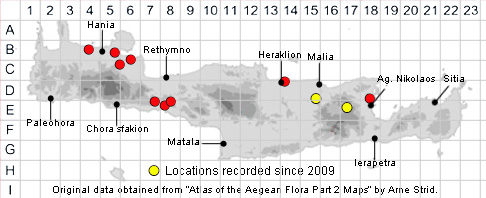
Distribution:- A widespread and variable Euro-Siberian species. Limited distribution
and rare on Crete, But may well be under recorded.
Flowering time:- May-July.
Photos by:- Steve Lenton